
The Unforgotten Pain: The Monumentalized Truth of the Guba Genocide

In 2007, during construction work in the city of Guba, a horrifying secret hidden beneath the ground came to light. A mass grave, accidentally uncovered during excavation, became undeniable evidence of one of the bloodiest crimes committed against Azerbaijanis in the early 20th century — the genocide carried out by Armenian-Bolshevik armed gangs in Guba in May 1918. During those tragic days, hundreds of innocent civilians — women, children, the elderly, and youth — were mercilessly massacred, regardless of their religion, age, or gender.
The revelation of this dreadful truth was not merely an archaeological discovery — it was the opening of a painful chapter in Azerbaijan’s national memory, the voice of a tragedy long silenced. To deliver this silent cry to the world, to inform future generations about this tragedy, and to ensure the eternal remembrance of the victims, President of the Republic of Azerbaijan Ilham Aliyev signed a decree on December 30, 2009, ordering the establishment of the “Genocide Memorial Complex” in the city of Guba.
The complex was constructed between 2012 and 2013 on the left bank of the Gudyalchay River, on the site of a former stadium, and was officially inaugurated on September 18, 2013. Covering a total area of 3.5 hectares, the complex consists of five main sections:

I. Memorial Monument
On April 1, 2007, during earthworks in the city of Guba, a mass grave was accidentally uncovered. In fact, it served as evidence of the horrific genocide committed by Armenian armed groups in 1918. Initial investigations carried out by the Institute of Archaeology and Ethnography of the National Academy of Sciences of Azerbaijan revealed that the individuals buried in the grave — women, children, and the elderly — were peaceful civilians.To gain a more comprehensive understanding of the findings, the Scientific Council decided to launch large-scale research. The site now serves as the final resting place for the human remains recovered from the mass grave. This land has become a sacred site of testimony — every inch speaks of history, and its silence cries out in anguish.

II. Symbolic Cemetery
This section of the Memorial Complex symbolizes not only the memory of the tragedy but also the continuity of life. Here, apple trees — long regarded as a symbol of Guba and representing fertility, life, and renewal — have been planted. This orchard serves, on one hand, as an expression of respect for the souls of those who rest in eternal sleep, and on the other, as a silent testament to the will to live.In the apple orchard, forty symbolic marble headstones of varying sizes — small, medium, and large — have been installed to represent three age groups of the victims of the bloody tragedy of May 1918: women, children, youth, and the elderly. These stones are not only markers for the nameless innocent but also enduring symbols of a pain etched into the collective memory of an entire nation.

IV. Information Center
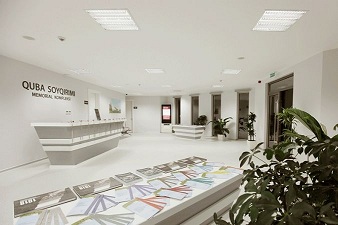
This section provides researchers, tourists, and visitors with a wide range of materials. The comprehensive information database includes documents, archival records, and other evidence related to the genocide.
Thanks to the support of the Heydar Aliyev Foundation, the Information Center within the complex is equipped with modern technology and offers access to a rich library, a reading hall, audio guides, and 16 types of booklets and publications in three languages, all reflecting the historical facts of the genocides that occurred in various regions of Azerbaijan in 1918.
V. Flag Square
The Guba Genocide Memorial Complex is not merely a monument — it is a living embodiment of the national memory, cultural identity, and historical consciousness of the Azerbaijani people. The tricolor flag that waves above this complex is more than a state symbol; it carries profound spiritual meaning.
It serves as a sacred reminder — not to forget the tragedies of the past and to show future generations the immense pain and sacrifices through which freedom and independence were achieved.Flag Square not only offers visitors a place to express deep respect and reverence for the souls of the victims, but also fulfills the mission of keeping their sacrifice and love for the homeland alive. Every step taken here, every glance, and every breath is dedicated to the memory of those who gave their lives for freedom.
It is a greeting to the spirits of the martyrs, and a message to the generations to come.
Author: Mehriban Aliyeva
Deputy Director of the “Genocide Memorial Complex”