

The Secret of a Successful Quiz

July 14 is celebrated as World Intellectual Games Day. This category includes various quizzes and tournaments. For several decades, intellectual games in our country were primarily associated with TV shows and in-person tournaments featuring experts. However, in recent years, quizzes have taken the lead in this field.The quiz format originally emerged abroad. Initially, quizzes were simple question-and-answer games, mostly held as part of evening gatherings in pubs, cafés, and restaurants. Modern quizzes, however, are evolving rapidly—adapting to the tastes of different audiences, becoming more diverse and complex. Sometimes, you even come across quizzes that approach the level of “What? Where? When?”But this is not their main advantage. The key benefit of this format is that it encourages modern individuals—who are often absorbed in their gadgets and withdrawn into their own “shells”—to step out of that state and spend a few hours engaging in fun games and live communication.So, how do you attract an audience to your quiz? What does organizing a quiz give to its host (apart from profit)? To answer these and many other questions, we spoke with the organizers of four different quizzes currently active in our city. They shared the origin stories of their projects, the formats they use, their audiences, and the most valuable feedback they’ve received from grateful participants.

Their answers help us understand why the quiz format has been spreading so rapidly—not only in our city but around the world. Let’s start with those who, without exaggeration, stood at the roots of quiz culture in Azerbaijan. Sanan Mahmudov, co-organizer of Fibonacci, the oldest quiz in Baku and the capital in general, which has been successfully running for 8 years, shares the story of its origins and strengths:
— In 2016, we founded a company called Fibonacci. We initially started by developing a board game and later created a mobile game. In 2017, following the advice of some friends, I traveled to Moscow, where I had the opportunity to observe and evaluate the quiz movement that was quickly gaining popularity there. Upon returning to Baku, I teamed up with an old friend to launch our own quiz.Before us, intellectual games in Russian were occasionally held in restaurants in Baku—about once every 1.5 to 2 months. But we were the first to start hosting these games regularly every week, in both Azerbaijani and Russian. We created our own format and standards, which later inspired other quizzes that emerged after us. This is not a franchise—it’s a completely local “Made in Azerbaijan” brand.At Fibonacci Quiz, the questions vary in format and difficulty. The game usually starts with easier questions to ensure a low entry threshold, so that participants coming straight from work can adapt smoothly. Then, the level of difficulty increases gradually.One of the unique highlights of our quiz is our trilingual host, Ismayil Aliyev, known for his charismatic voice, intelligence, manners, and sense of humor—which always fascinates Fibonacci’s players.Initially, most of our participants were people who had either played “What? Where? When?” at least once or had watched intellectual games on TV. Over time, newcomers also started joining us. The average age of participants used to be around 30–35, and it remains the same today. Even though the original active players are now over 40, they continue to play. Young people and students are constantly joining in and are very active.We signed a cooperation agreement with the Science Development Foundation and offered a record-breaking 75% discount for a state institution. Now, all students with a TələbəPlus card receive a 75% discount on participation in our games.

In short, at the Fibonacci Quiz, you’ll find people of all ages—those who prefer intellectual leisure. What’s especially gratifying is that we were the ones who managed to popularize this form of entertainment, making it attractive not only to private companies but also to government institutions. A brand-new format of intellectual and entertaining recreation emerged in the country, which in turn helped develop other areas of team-building.We began offering the market not only the traditional “question–answer” format but also task–solution models, quests, business simulations, corporate Olympics, and more. Our weekly games feature classic quiz questions, while the corporate events are a bit simpler in content. That’s because our weekly sessions include competition for prizes, the seasonal champion title, and a grand prize fund of 2025 AZN. In contrast, the primary goal of corporate games is team building—enhancing communication, encouraging discussion, and strengthening collaboration skills, all of which are crucial in the corporate environment.Simply put, we’re proud to have created a market in which, every week, some private or public institution books a corporate quiz for its employees. What’s even more rewarding is that in government procurement requests, the wording is often specific: “Games in Fibonacci format.” That means Fibonacci is not only the first quiz chronologically in the country but also the most popular. Our brand name has essentially become an eponym, like “Jeep” or “Xerox”—a synonym for the entire category of services.Each week, we receive heartfelt messages of appreciation and well-wishes—not just from weekly quiz participants but also from employees who attend corporate games. But the most precious and emotional feedback we get is when a couple approaches us and says:“Thank you—we met because of your quiz and ended up getting married.”As far as we know, ten families have been formed this way. I believe that’s the emotional peak anyone can experience—seeing how your project has brought people happiness and changed their lives for the better.After all, our quiz is not just a game—it’s a social platform where people meet, make friends, launch joint projects, and in some cases, even get married.In reality, we’re not selling a “game”—we’re selling emotion.And for us, the best feedback sounds like this:
“Fibonacci Quiz is our favorite quiz.”
Because love—that’s something money can’t buy.

In 2018, a new quiz franchise—Jack Quiz—emerged on the radar of Baku’s intellectual game enthusiasts. The project quickly found its niche, proved to be successful, and continues to thrive today. It is especially beloved by those who once participated in “clubs of the knowledgeable.” One of the Baku co-organizers of the project, Vugar Zeynalov, shares what makes Jack Quiz special:
“The Jack Quiz project was first launched in January 2015 in Minsk (Republic of Belarus). It was created by Vitaliy Zakharik, editor of the Belarusian TV club ‘What? Where? When?’ (WWW), along with experienced players and organizers Sergey Buyan and Olga Yaroshenko. Today, the franchise is being developed by Aleksandra Cherkashina and Dmitry Chernyshov from Saint Petersburg. The quiz is now held in various cities across Russia, Azerbaijan, Kazakhstan, and Belarus. Among the hosts of the quiz in Moscow and St. Petersburg are seasoned intellectual players: Mikhail Mun, Boris Belozyorov, Dmitry Avdeenko, Yuri Filippov, Vladimir Antokhin, and Pavel Ershov.Our Baku-based Jack Quiz launched on May 1, 2018. At that time, this movement was just beginning to take off in Azerbaijan—there were literally only one or two other quizzes in the city. And because this type of game format was unfamiliar to most people back then, it was very difficult for us to find a suitable venue to host it.Choosing a restaurant for the quiz requires taking many factors into account. For example, the size of the hall (which depends on how many teams will participate) and the presence of necessary technical equipment like screens and projectors. Additionally, it’s important to agree with the restaurant on the exact day of the week for the event. Quizzes are usually held in the evenings on specific days (our Jack Quiz takes place on Mondays). But sometimes the required day doesn’t align with the restaurant’s availability, creating additional challenges.These days, many more people in Baku—including restaurant managers—know what a quiz is. But even now, it’s not always easy to find the right venue for such events. On the other hand, a well-chosen location can help attract a new audience to the quiz, which plays a key role in the project’s growth.”

But let’s get back specifically to Jack Quiz. What made this quiz particularly interesting for me was that, in terms of both question format and difficulty level, it was the closest to What? Where? When? (WWW). After all, both I and most of the people around me are players of WWW. For example, I joined the intellectual movement back in 1993, and later I led the “Club of the Knowledgeable” for many years…The idea of acquiring this franchise came to me when one of our What? Where? When? club members, Ruslan Mammadov—who was studying and working in Poland at the time—told me that he was attending several quiz events there, but the most interesting by far was Jack Quiz. I tracked down the contact information for the franchise owners (they were still based in Minsk at that time), reached out to them, and we came to an agreement almost immediately—since we already knew each other, as they were also players in the Belarusian What? Where? When? community.Taking this opportunity, I’d like to say a few kind words about our co-organizers in Minsk and Saint Petersburg: their work is extremely professional, they respond quickly to any requests, and they provide all the necessary support — I’m very satisfied with this partnership.Since our questions are of medium and medium-high difficulty (arguably the most challenging among Baku’s quizzes), Jack Quiz mainly attracts experienced players, and the majority of participants tend to be middle-aged or older. However, there are also young players—we do our best to involve them, as it’s essential to have a diverse mix. In fact, we fully support the idea of maximum diversity among players.The defining feature of Jack Quiz is its balanced combination of the competitive format of WWW and a more entertaining quiz approach. One especially exciting part is the final round—“The Auction”, which can completely change the outcome of the game. A team at the bottom of the scoreboard can suddenly jump into the top three. This format is exclusive—no other quiz uses this type of mechanism.Another unique aspect of the franchise is that every Jack Quiz round is thematic, and the topics are absolutely unpredictable. It really stimulates the brain. As for how such questions are created, the franchise leaders could probably explain it best. I asked them this question, and here’s the answer I received:“Our questions are designed so that almost all of them contain a logical element. In other words, the answer can be reached through reasoning. At the same time, a certain base of knowledge is required—and this is the key feature that distinguishes Jack Quiz.”I’ve heard this feedback many times:“Your quiz has the most interesting questions.”And that’s always wonderful to hear, because in my opinion, questions are the core of any intellectual game—including quizzes.

In 2024, a new and rapidly growing project joined the family of quizzes in Baku — MeetUp-Quiz, which is part of the larger and multifaceted MeetUp teambuilding initiative. One of the project’s organizers, Viktoriya Sosnovskaya, shares insights into the concept behind this uniquely formatted quiz:
“MeetUp-Quiz emerged as a natural extension of our broader MeetUp project, which had already successfully launched Mafia games and themed parties. We wanted MeetUp to offer not only emotional experiences, but also opportunities to stimulate thinking. The quiz format brought together everything we love — humor, team spirit, excitement, the energy of a lively room, and interesting new connections.Our goal was to create not just a game, but an atmosphere where everyone feels like part of a community — whether you’re an introvert, new to the city, or a regular attendee. The audience of MeetUp-Quiz is a vibrant mix of strong and diverse individuals, which makes the quiz truly unique. We’ve built a format that’s accessible even to those who’ve never played What? Where? When?, other quizzes, or any kind of intellectual games — yet it’s also engaging for experienced players used to championship-level formats.The average age of participants ranges between 23 and 40. We welcome students, company executives, IT specialists, doctors, designers, and professionals from many other fields. It’s amazing to see how the game brings such different people closer — and that’s what brings us the most joy. What matters isn’t your prior experience, but your willingness to be in the moment: to listen, guess, discuss, celebrate the correct answer, and connect with your team.MeetUp-Quiz is not just a game — it’s about trust, friendship, and humor. And those who come once often return again and again. We don’t work under a franchise model. All our games are original and created in-house by our team for each specific evening and venue. This allows us to tailor everything — from the content to the vibe — according to the audience, the venue’s style, the format of the event, and even the weather if we choose to.To us, a quiz isn’t a dry test of knowledge — it’s a form of intellectual entertainment with personality and emotion. We design our questions in a way that even those who don’t know the exact answer still feel part of the process.So, what are our questions like? First of all, they vary in difficulty — engaging for beginners and challenging enough for veterans. They come with humor — often witty or sarcastic, featuring unexpected twists and avoiding clichés. We love questions that rely on logic, observation, and quick thinking — we enjoy surprising people. The topics revolve around life and everything around it: pop culture, movies, music, life hacks, and everyday paradoxes.The goal isn’t just to ask a question, but to involve, surprise, entertain, and spark dialogue within teams. After all, a quiz isn’t an exam — it’s an evening that should stand out and leave you thinking, “Wow, that was amazing!”Our quiz is a unique product, and that’s where its strength lies. We don’t follow templates — we create games with character. That’s our philosophy.”

As the organizing team, there are three of us, and each of us brings a unique strength to the table. One is responsible for visual design and marketing, another handles the game mechanics, and the third focuses on the atmosphere, creativity, and audience engagement. Together, we complement each other perfectly. Yes, we’re not just a team — we’re a synergy.Of course, we’ve faced our fair share of challenges. The toughest part was setting up the logistics: assembling a strong team, adapting the format to the audience, and coordinating with venues and partners. But it was precisely these challenges that helped us grow: the quiz evolved into an original, in-house project, complete with its own quirks, creative questions, and show elements. Today, MeetUp-Quiz is more than just a game — it’s a part of Baku’s cultural and intellectual life. And we’re only at the beginning of the journey. Ahead of us lie even more quizzes, new themes, formats, partnerships, and unforgettable emotions.The main “trick” of MeetUp-Quiz is its show format — an intellectual game that turns into a full evening of entertainment and relaxation. We go beyond the limits of a classic quiz and create a party-like atmosphere. During breaks, there are live performances — singers, DJs, and music bands take the stage. We combine the excitement of the game with the energy of a dance floor, giving participants a chance not only to answer questions but also to unwind after a long day at work.People come to us not just to play — they come to recharge, have fun, and feel like part of a vibrant community. It’s not only about knowledge, it’s about mood. That’s why MeetUp-Quiz isn’t just a game — it’s an evening that everyone looks forward to.People return again and again, bringing their friends along — and that is the clearest sign that we’re creating something truly valuable. When someone tells us, “You don’t just host a quiz — it’s a real event, something you’d want to invite your friends to,” — that’s the greatest compliment we could receive.

In the recent past — just this summer — another popular franchise, Mozgoquiz, burst onto Baku’s entertainment scene. Its local co-organizer, Orkhan Abdullayev, explains what intellectual game lovers can expect from this quiz, and why, in his opinion, quizzes have practically replaced traditional knowledge clubs:
By the time I decided to acquire the Mozgoquiz franchise, I already had some experience in this field. Back in 2018, I launched my first quiz, called “Kinoliga”. At that time, the niche — specifically movie-themed quizzes — was completely open in Baku, so I chose that theme. By the way, Kinoliga is still alive; we occasionally run it. But now, I own the Mozgoquiz franchise. The questions are provided by the franchisers, and in my opinion, the difficulty is ideally balanced: 50% easy, 30–40% medium, and 10–20% truly difficult.I chose this franchise because Mozgoquiz was the very first quiz I ever played — back in 2015 in Berlin. Since then, I’ve been in love with quizzes. The opportunity came up — and I took it. Organizing a quiz is a fascinating job, but it comes with its own challenges. Like in any field, really. For example, even during the Kinoliga days, I realized that the most important aspect of quiz organization is finding the right venue. Not every restaurant will allocate their entire hall for a quiz, so the ideal locations are those with separate wings or floors that can be fully closed off during the event. Of course, a restaurant’s willingness to host often depends on how much money the quiz guests are likely to spend there. Generally, the audience at these events is aged between 30 and 50 — in other words, not students, but people with solid spending power who actively order food and drinks.I’d also like to touch on what was happening before quizzes emerged in Baku. For many years — practically since Azerbaijan gained independence — the local intellectual community was immersed in playing “What? Where? When?” (WWW). I myself joined the movement as a high school student back in 2003, which was the peak of the game’s popularity.And by “What? Where? When?”, I don’t just mean that specific game, but the whole world of traditional intellectual competitions — such as Brain-Ring, Jeopardy-style games, and others. Official tournaments and championships were held in these formats. In general, we’re talking about all forms of intellectual game activity.This knowledge movement maintained continuous popularity in Azerbaijan for over 25 years. In addition to several officially registered intellectual clubs, Baku also had many informal WWW clubs — at universities, and even at some secondary schools. But around 10 years ago — maybe a bit less — things began to change. The popularity of traditional knowledge clubs started to decline. And that’s when the first quizzes started to appear in Baku.Interestingly, people who used to play in knowledge clubs were initially reluctant to participate in quizzes — probably due to a sense of snobbery and elitism that many “experts” had (and let’s be honest — it’s not something we can deny).


P.S.
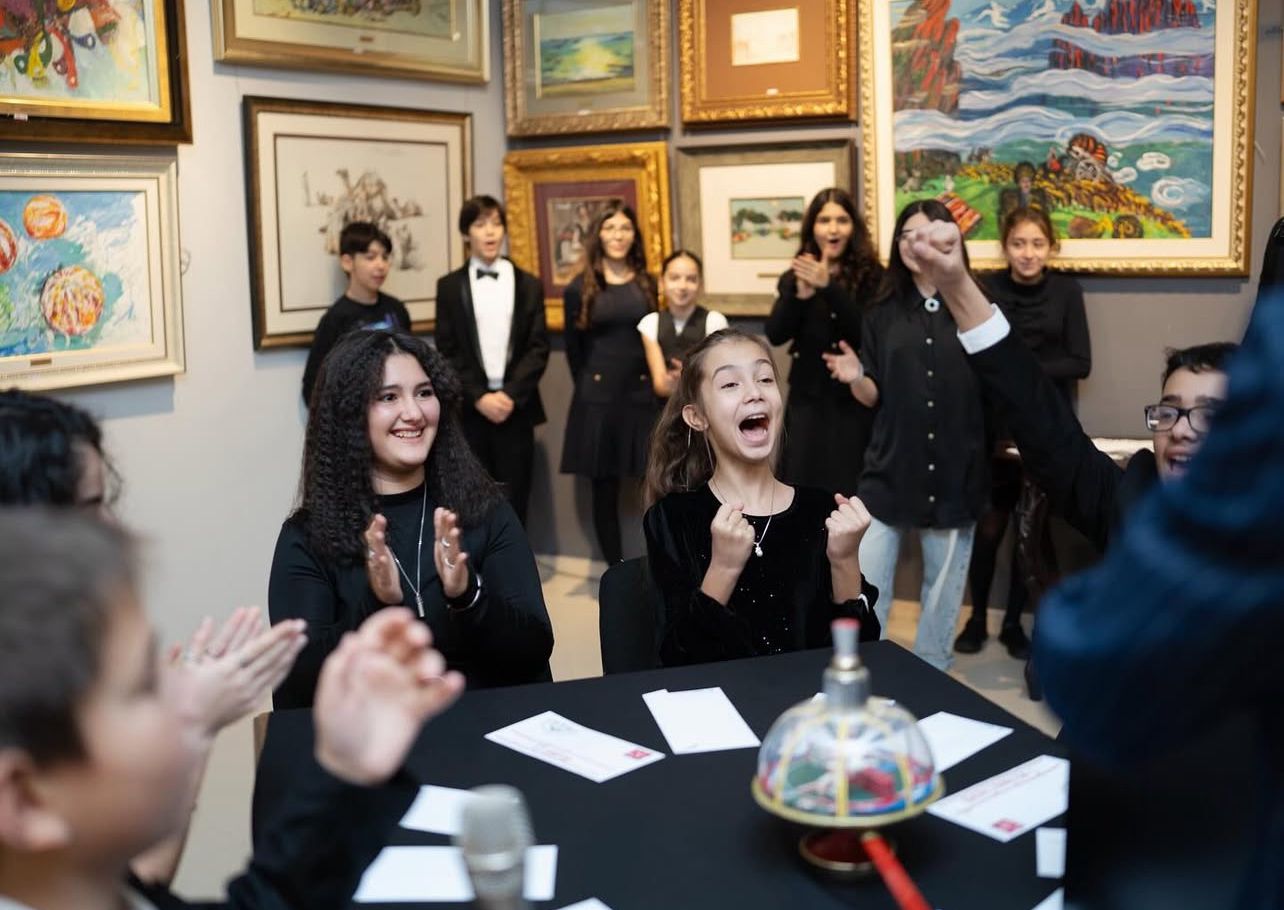
The popularity of any hobby can also be measured by how many young people and children it attracts. Despite the immense success of quizzes, traditional intellectual games are still thriving in Baku. A bright example of this is the “What? Where? When?” course held at the Art & Creativity Club, located in the Caspian Plaza building. This club is essentially a hub for the youngest knowledge enthusiasts.
Here, children and teenagers aged 9 and above participate in the “What? Where? When?” course. The games and lectures are conducted in several languages, including English. It’s an engaging blend of theory and practice that helps expand students’ worldview and develop their critical thinking.
Young players solve riddles, logic problems, and puzzles designed to enhance logical thinking and creativity. They dive into the fascinating worlds of science, art, sports, and other areas of knowledge, while also learning to work effectively in teams. Professional experts — winners of the Azerbaijan Cup in “What? Where? When?” — guide and support them on this journey.
Members of the Art & Creativity Club have the right to participate in the club’s own tournaments, as well as in national-level competitions and championships.
It’s worth noting that in December 2024, teams of 6th and 7th graders from the club participated in the Azerbaijan School Championship in “What? Where? When?” and secured 1st and 2nd places in both the qualifying rounds and the finals.
As it continues to reach new heights, the Art & Creativity Club invites schoolchildren to spend their time meaningfully, acquire new skills, and connect with peers who share their interest in intellectual challenges.
Müəllif: Nailə Bənnayeva


FORTUNA Рекомендует

Что важнее: быть счастливым или правым?
07.11.2016
8 японских пословиц, в которых заключена вся мудрость этого народа
15.01.2020
