
Historical Overview of the Multani Caravanserai — Vafa Guliyeva and Hokyuma Agayeva

Caravanserais were divided into two types: city caravanserais and those located along caravan trade routes. Both types were fortress-like structures without windows, featuring a single entrance door, loopholes, and surrounded by strong walls. The caravanserais situated on trade routes were complex monuments. The complex included separate guest rooms, warehouses, wells, mosques, and stables.
The Multani Caravanserai is located in Icherisheher, opposite the Bukhara Caravanserai. It was built in the 14th century for Zoroastrian merchants arriving from the city of Multan in India (now located in Pakistan). The architectural and planning structure of the caravanserai consists of galleries surrounding the courtyard along the perimeter, with separate rooms behind them intended for living quarters.
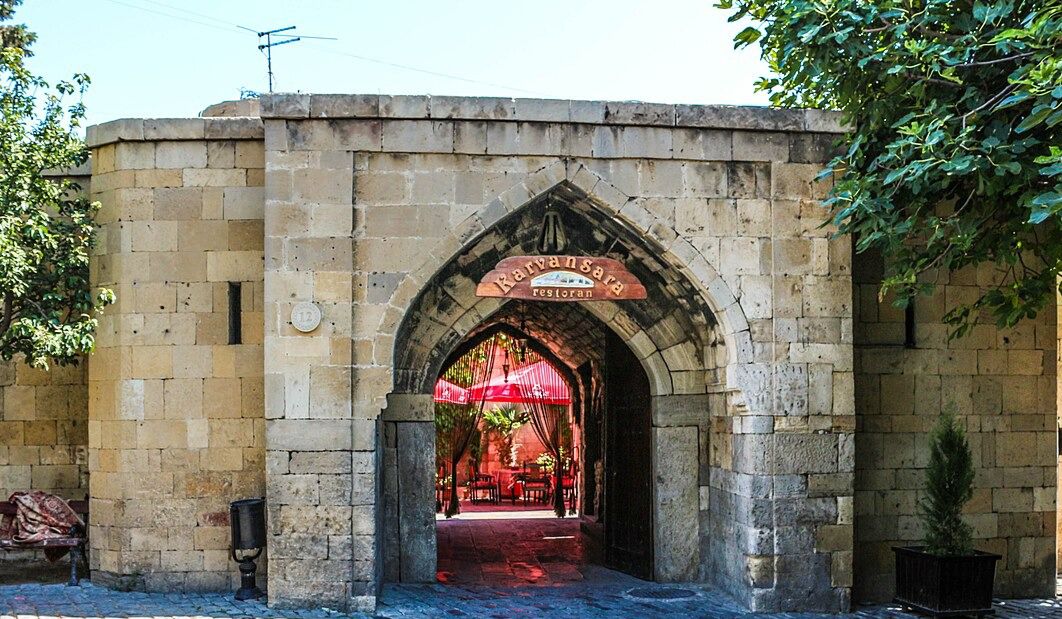
The entrance to the caravanserai is designed as a deep portal topped with a pointed arch. Behind the massive wooden gates begins a passage covered by a pointed vault leading into the courtyard. The end of the passage is also finished with an arch of the same height as the living rooms and galleries. Thus, the arches forming the octagonal courtyard are all at the same height. One of the rooms adjacent to the passage was converted into a stairwell leading to the basement.
The Multani Caravanserai was built according to a traditional compositional scheme. From the trade street side, it appears as a one-story building with a simple facade measuring 35 by 35 meters. Inside is a closed octagonal courtyard with isolated living rooms. In the southwest part of the building, six living rooms with their original layout have been preserved to this day. Three of them open to the courtyard through a common terrace with a hexagonal pointed arch and an interesting vaulted ceiling. The other three rooms each have their own terraces of the same height but different widths.
The rooms in the northwest section of the caravanserai have not survived — a garden was laid out in their place. The basement of the Multani Caravanserai is one of its most interesting parts. Today, from the side of the 20th-century residential building occupying the eastern part of the complex, the basement is perceived as the first floor, with its floor level about 60 cm below the asphalt level. Currently, the caravanserai is at the level of the second floor. Thus, the visible part now is the second floor of the building, while the first floor and basement remain underground.
Experts note that this annex is stylistically and functionally unrelated to the caravanserai. It consists of four long rooms covered with cylindrical vaults. The lower part of the building (the underground level) extended eastward. During the construction of the residential building in the early 20th century, this part of the monument was destroyed.
The main construction materials of the monument were small blocks and limestone with a fine-grained structure, traditional for the Shirvan-Abseron architectural school. The building’s foundation consists of natural rock mass. The vaulted ceilings of the older underground rooms are made from precisely hewn building stones bonded with a complex lime mortar.