
Uzeyir Hajibeyov: Life, Creativity, Legacy

Uzeyir Hajibeyov was born on September 18, 1885, in Aghjabadi. His father was Abdulhuseyn bey, and his mother was Shirinbayim khanum. His father served as a village scribe, while his mother came from the noble Aliverdibeyli family. The family had three sons and two daughters. Shortly after Uzeyir’s birth, the family moved to Shusha, one of Azerbaijan’s key cultural centers, where he grew up.The future composer’s father served for a long time as the personal secretary of Khurshidbanu Natavan — a poet, public figure, and the daughter of the Khan of Karabakh. This close connection played an important role in shaping Uzeyir’s character and development as a composer. His mother, Shirinbayim khanum, had also been raised in Natavan’s household. These circumstances were among the primary factors in the formation of the great composer.Thanks to Natavan khanum, Uzeyir bey had the opportunity to participate in the best musical gatherings and literary-musical events in Shusha. In his youth, he received mugham lessons and learned to play traditional musical instruments. In 1897, at the age of 13, he performed as part of the choir in the play Majnun at Layla’s Grave, staged by Abdurrahim bey Hagverdiyev and Jabbar Garyaghdyoglu.After receiving education at a madrasa and a two-year Russian-Tatar school, he studied at the Gori Teachers’ Seminary from 1899 to 1904. There, he learned to play the violin, cello, and wind instruments, and met the well-known composer Muslim Magomayev (the grandfather of the famous singer of the same name). Over the next four years, he worked as a teacher in schools in Hadrut and Baku.
In 1909, Uzeyir bey Hajibeyov married Maleyka khanum Teregulova. Though the couple had no children, Maleyka khanum was not only his wife but also a loyal supporter of his scholarly and creative activities. After his death, she played an active role in the publication of his works.The composer’s first article was published in 1904 in the Kaspi newspaper. In 1905, he began teaching at the Bibiheybat school, and later at the Saadat school, where he taught Azerbaijani language, mathematics, geography, history, and Russian. From 1914 to 1918, he served as the editor and owner of the Yeni Iqbal newspaper and later led the Azerbaijan newspaper. In June–September 1918, he led a tour of Azerbaijani opera artists to the cities of Anzali and Rasht in Iran.In 1931, he founded the Folk Instruments Orchestra, and in 1936, the State Choir. On May 7, 1938, Uzeyir bey submitted an application to join the Communist Party. Taking into account his contributions and upon recommendation by the Central Committee of the Azerbaijani Communist Party, the Central Committee of the Communist Party of the Soviet Union admitted him as a party member without a candidacy period. That same year, he was awarded the Order of Lenin and granted the honorary title of People’s Artist of the USSR.In 1939, he was appointed rector of the Azerbaijan State Conservatory and elected a member of the organizing committee of the First Congress of the Union of Soviet Composers. During the last 10 years of his life, he led the Union of Azerbaijani Composers. In 1943, he donated 25,000 rubles of his personal funds for the creation of a tank column.
Between 1904 and 1920, Uzeyir Hajibeyov wrote nearly 600 articles on various topics. However, after the Soviet occupation, he wrote only about 30 more articles until the end of his life, most of which were dedicated to music.In 1947, Uzeyir Hajibeyov began suffering from diabetes. He initially received treatment at the Kremlin Hospital in Moscow and was later moved to a state sanatorium in Mardakan. He passed away from heart failure around 2:00 AM on November 23, 1948, in his apartment on the fourth floor of the “Monolith” building in Baku. He was buried in the First Alley of Honor.

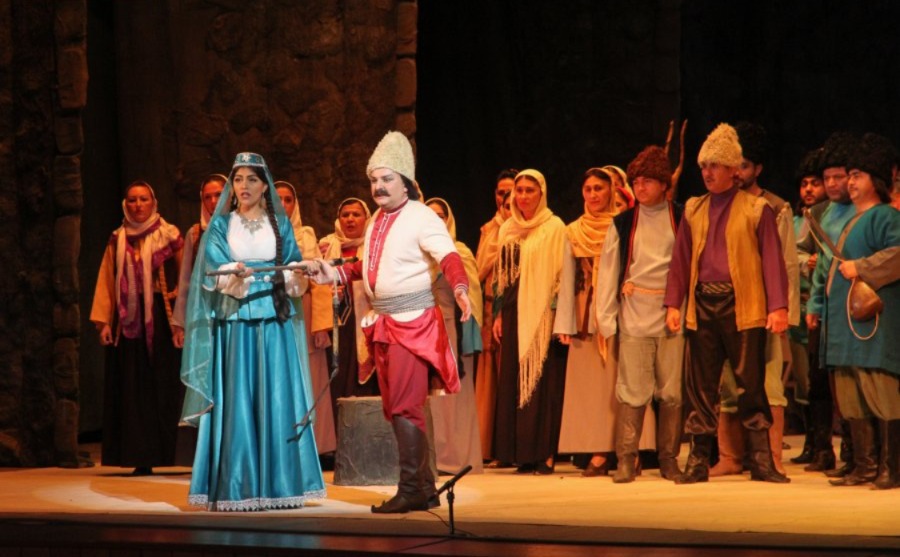
Uzeyir Hajibeyov combined Western and Eastern musical traditions, adapting elements of Azerbaijani folk music to the rules of classical Western music. Using this method, in 1908 he created the first Azerbaijani opera, Leyli and Majnun, based on the poem of the same name by Fuzuli. His second opera, Sheikh Sanan, written in 1909, had a distinct style as it was based entirely on original music composed by the author.
Between 1910 and 1915, he wrote the operas Rustam and Zohrab (1910), Shah Abbas and Khurshud Banu (1911), Asli and Kerem (1912), and Harun and Leyla (1915). His most magnificent work, Koroghlu, was written in 1936 and awarded the Stalin Prize in 1941.
In total, Uzeyir Hajibeyov wrote 7 operas and 3 operettas: Husband and Wife (1909), If Not That One, Then This One (1910), and The Cloth Peddler (1913). Except for Koroghlu, the librettos for all the operas were written by Hajibeyov himself. His unfinished opera Firuze was later completed by Ismayil Hajibeyov.
Uzeyir bey also created the chamber vocal genre known as the “romance-ghazal,” composing Without You (1941) and Beloved Beauty (1943), based on the verses of Nizami. He is also regarded as the founder of the Azerbaijani opera school.
In his book Uzeyir Hajibeyov and Azerbaijani Music, Viktor Vinogradov wrote:
“…His contributions are truly immense. It is no coincidence that in Azerbaijan, opera has become a popular musical genre…”

In 1918, Hajibeyov composed the National Anthem of the Republic of Azerbaijan. From 1920 to 1991, during the period when the republic was part of the USSR, this anthem was no longer performed. However, in 1930, on the occasion of the 10th anniversary of Soviet rule, Uzeyir bey composed both the music and lyrics for a new anthem for the Azerbaijan SSR. This anthem was first performed on April 28, 1930. Due to its stylistic similarities with a cantata, it is sometimes also referred to as a “cantata.”
In 1944, he composed another anthem for the Azerbaijan SSR, which remained in use until the republic separated from the Soviet Union. In 1991, the original anthem composed in 1918 was reinstated as the official national anthem.
Uzeyir Hajibeyov is the architect of Azerbaijani music, a great artist who spoke to his people through notes. His legacy is not only a reflection of a specific era but a manifestation of the memory of an entire nation. His birthday, September 18, is celebrated annually as National Music Day. This day is not only a tribute to an individual but also a celebration of the triumph of our national musical art.
Today, Uzeyir bey’s name has been given to the Baku Music Academy (formerly the Azerbaijan State Conservatory), the Azerbaijan State Symphony Orchestra, and a street in Baku. Additionally, a state award for outstanding contributions to the field of culture is named in his honor.
The composer’s memory is also preserved through monuments and museums: in 1956, a statue was erected over his grave (sculptor: Ömər Eldarov), and in 1960, another monument was installed in front of the Conservatory (sculptor: T. Mammadov). His house museums were opened in Shusha in 1959 and in Baku in 1975.
Uzeyir bey’s life and creative work have served as the subject of both documentary and feature films. In 1976 (director: Khamis Muradov) and 1986 (director: Zaur Maharramov), documentary films were produced, and in 1981, the feature film “Uzeyir’s Life” was directed by writer-playwright Anar. The role of the composer was portrayed by Huseynagha Atakishiyev.
Uzeyir bey’s artistic legacy is recognized internationally: his busts have been erected in Vienna (2006), in the city of Novi Sad, Serbia (2011), and in Shusha (2021). In 2008, under the auspices of UNESCO, the 100th anniversary of the opera “Leyli and Majnun” was celebrated with great ceremony. On December 9, 2020, a city garden in Saint Petersburg was named in his honor.
All of these achievements are vivid examples of the cultural policy implemented by the President of the Republic of Azerbaijan, Ilham Aliyev, and the First Vice-President, Mrs. Mehriban Aliyeva. Their attention to culture and to the people of the arts serves to promote Azerbaijan’s national musical heritage worldwide and ensure the preservation and transmission of classical art to future generations. The high value placed on Uzeyir Hajibeyov’s legacy is both a tribute to the past and a reflection of faith in the future.
Author: Saida Musayeva, Editor-in-Chief of Fortuna Magazine